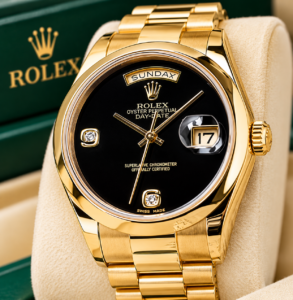
Gold Day-Date Watch | Luxury Design & Features
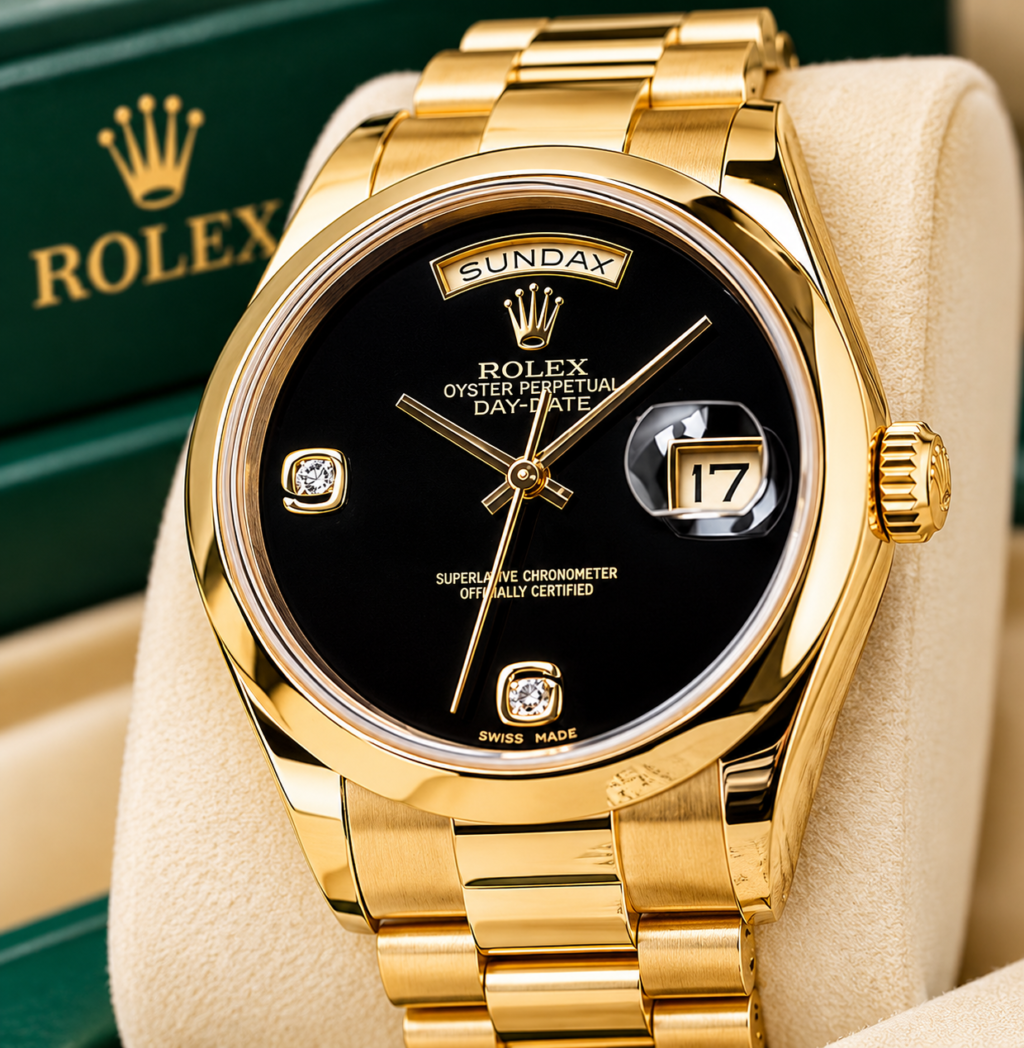
A Gold Day-Date Watch represents a distinctive combination of classic watchmaking, refined design, and practical functionality. Its elegant gold appearance, carefully designed dial, and day-and-date display make it a recognizable style in the world of luxury wristwatches. When paired with a black dial and diamond-style hour markers, the design creates a sophisticated contrast that suits both formal occasions and smart everyday outfits.
However, a luxury watch is more than its appearance. Its quality also depends on the materials used, movement technology, finishing, construction, accuracy, and long-term reliability. Understanding these details helps buyers evaluate a Gold Day-Date Watch more carefully and choose a timepiece that meets their expectations.
This guide explores the design, features, materials, movements, maintenance requirements, and important buying considerations associated with gold Day-Date-style watches.
1. Understanding the Gold Day-Date Watch
The Day-Date design is known for displaying the day of the week and the date on the dial. This arrangement provides useful calendar information while maintaining a balanced appearance.
The Rolex Day-Date collection was introduced in 1956 and became particularly recognizable for its day display written in full at the 12 o’clock position and date window at 3 o’clock. Today, many watches use a similar day-and-date layout, although their brands, construction, materials, and movements may differ.
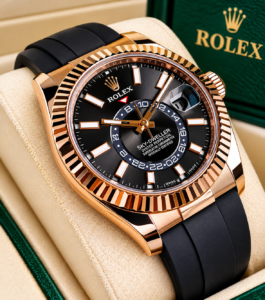
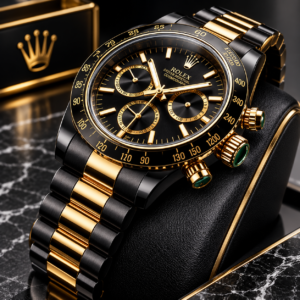
A Gold Day-Date Watch generally combines a gold-colored case or bracelet with a dial designed for clear time reading. Some models feature a black dial, decorative hour markers, and a magnified date window. These details create a traditional luxury-inspired appearance.
It is important to distinguish between a genuine Rolex Day-Date and another watch with a similar design. Appearance alone does not establish a watch’s brand, authenticity, or material quality.
2. Black Dial and Gold Finish
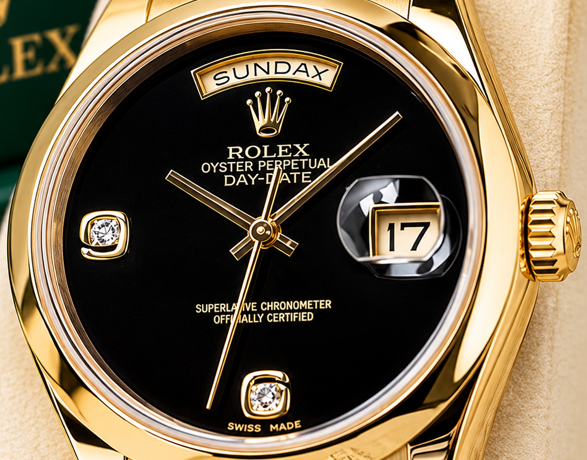
The combination of a black dial and gold-colored case creates a strong visual contrast. Black provides a dark, balanced background, while the gold finish adds warmth and definition to the watch.
A black dial can have several finishes:
- Glossy finish: Reflects light and creates a polished appearance.
- Matte finish: Reduces reflections and offers a subtle, understated look.
- Sunray finish: Creates a light-reflecting pattern that changes with the viewing angle.
- Textured finish: Adds visual depth through a patterned surface.
The choice of dial finish affects the overall appearance and readability of the watch. Clear hour markers and well-positioned hands are particularly important because they help users read the time quickly.
A black dial also provides a versatile background for gold hands, indices, and decorative details.
3. Gold Case Materials and Construction
The case protects the movement and supports the overall structure of a wristwatch. Its material affects durability, weight, appearance, and maintenance requirements.
Not every gold-colored watch is made from solid gold. Manufacturers may use several different materials and finishing methods.
| Material | Main characteristics |
|---|---|
| Solid 18-karat gold | Contains 75% pure gold mixed with other metals for strength |
| 14-karat gold | Contains approximately 58.5% pure gold |
| Gold-plated stainless steel | Uses a thin gold layer over a stainless-steel base |
| Gold-tone stainless steel | Stainless steel with a gold-colored surface finish |
| Gold-capped construction | Uses a thicker gold layer bonded to a base material |
The material should always be confirmed through reliable product documentation. A gold-colored appearance does not prove that a watch contains solid gold.
Understanding Gold Purity
Gold purity is measured in karats.
| Gold purity | Gold content |
|---|---|
| 24K | Approximately 99.9% |
| 22K | Approximately 91.7% |
| 18K | 75% |
| 14K | Approximately 58.5% |
Pure gold is relatively soft, so watch cases and bracelets commonly use gold alloys rather than pure 24-karat gold. These alloys combine gold with other metals to improve strength and suitability for everyday construction.
4. Black Dial Design and Readability
The dial is one of the most important visual and functional parts of a watch. It displays the time and may include additional features such as the day, date, and decorative hour markers.
A well-designed black dial should provide:
- Clear contrast between the hands and background.
- Properly aligned hour markers.
- Readable day and date displays.
- Balanced spacing between dial elements.
- A finish that suits the overall case design.
The hands should be easy to distinguish from the hour markers. If the dial includes decorative stones or reflective surfaces, their placement should not make time reading unnecessarily difficult.
Dial quality also depends on finishing. Smooth surfaces, clean printing, precise alignment, and consistent detailing contribute to a more refined appearance.
5. Diamond Hour Markers and Decorative Details
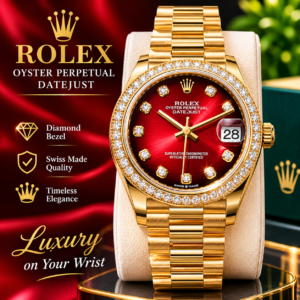
Some Gold Day-Date-style watches feature diamond hour markers or diamond-inspired decorative elements. These details add brightness and visual interest to the dial.
Genuine diamonds and imitation stones are different materials. Their appearance may be similar in photographs, but their value, composition, durability, and verification requirements are not the same.
Before describing a watch as diamond-set, buyers should confirm:
- Whether the stones are natural diamonds, laboratory-grown diamonds, or imitation stones.
- Whether the stones have been professionally set.
- Whether documentation is available.
- Whether the placement and finishing are consistent across the dial.
Decorative markers should complement the dial rather than reduce its readability. A balanced design combines visual detail with practical use.
6. Day and Date Display
The day-and-date complication is one of the defining functional features of a Day-Date-style watch.
The day window typically displays the weekday, while the date window shows the numerical day of the month. Depending on the movement, these displays may change automatically around midnight.
There are several important points to understand:
Day display: Shows the weekday, such as Monday or Tuesday. Some watches offer multiple language options, depending on their movement and design.
Date display: Shows the numerical date of the month. A standard date mechanism usually requires adjustment after shorter months.
Calendar adjustment: The correct adjustment procedure depends on the movement. Some watches have restricted adjustment periods, so the manufacturer’s instructions should be followed.
A properly functioning calendar mechanism should change smoothly and display information clearly.
7. Magnified Date Window
Some watches use a magnifying lens above the date window to make the date easier to read. This feature is commonly associated with certain traditional luxury-watch designs.
The magnifier can improve visibility, particularly when the date numerals are relatively small. Its performance depends on the lens shape, optical quality, alignment, and position above the date aperture.
When evaluating this feature, check that:
- The date is centered within the window.
- The magnifier does not create distracting distortion.
- The lens is securely fitted.
- The date remains readable from normal viewing angles.
Not every Day-Date-style watch includes a magnified date window. Buyers should check the actual product specifications.
8. Gold Bracelet Construction and Comfort
The bracelet contributes significantly to the appearance, fit, and comfort of a Gold Day-Date Watch. A gold-colored bracelet can create a consistent look when paired with a matching case.
Bracelet quality depends on several factors:
- Link construction and finishing.
- Secure connections between links.
- Smooth edges that do not irritate the wrist.
- A reliable clasp mechanism.
- Appropriate sizing and adjustment.
- Resistance to ordinary wear.
A well-fitted bracelet should feel secure without being excessively tight. The clasp should close properly and remain secure during normal use.
Some watches use solid gold bracelets, while others use gold-plated or gold-tone materials. These constructions differ considerably in weight, cost, and maintenance requirements.
9. Movement Technology
The movement is the mechanism responsible for keeping time and operating the watch’s functions. Its design has a major effect on accuracy, maintenance, and overall performance.
Automatic Movement
An automatic movement uses the motion of the wearer’s wrist to wind its mainspring. It does not normally require a battery, although it may need manual winding if it stops after being unused.
Automatic movements are appreciated for their mechanical construction and traditional watchmaking characteristics. Their accuracy varies according to movement quality, adjustment, condition, and usage.
Manual-Winding Movement
A manual movement requires the wearer to wind the crown periodically. This process stores energy in the mainspring, which powers the watch.
Manual-winding watches offer a direct connection with traditional mechanical watchmaking, but they require regular winding according to the manufacturer’s instructions.
Quartz Movement
A quartz movement uses a battery and a quartz crystal to regulate timekeeping. It generally requires less daily attention than a mechanical movement and can offer strong accuracy.
The correct movement type should be confirmed from the manufacturer’s specifications. A watch’s external design does not reveal whether it uses an automatic, manual, or quartz movement.
10. Sapphire Crystal and Watch Protection
The crystal is the transparent cover protecting the dial. Its material affects scratch resistance, clarity, and durability.
Sapphire crystal: Synthetic sapphire is widely used in quality watches because it offers excellent scratch resistance. It can still be damaged by sufficiently strong impacts.
Mineral crystal: Mineral glass is generally more affordable and offers reasonable everyday protection, although it is more susceptible to scratching than sapphire.
Acrylic crystal: Acrylic is relatively easy to polish and can be used in some traditional or vintage-inspired designs, but it scratches more easily.
Some crystals also include anti-reflective coatings to improve visibility. The presence of sapphire crystal should never be assumed without checking the official product specifications.
11. Case Size, Thickness, and Wrist Comfort
A watch should be comfortable as well as attractive. Case diameter, thickness, lug-to-lug length, and bracelet design all influence how a watch sits on the wrist.
A larger case may create a more noticeable appearance, while a smaller case can offer a more understated profile. However, there is no single ideal size for every wearer.
When evaluating case dimensions, consider:
- Case diameter.
- Case thickness.
- Lug-to-lug measurement.
- Bracelet width.
- Overall weight.
- Clasp design and adjustability.
The watch should sit securely without excessive movement. Trying it on, when possible, is a useful way to evaluate its fit.
12. Water Resistance and Everyday Protection
Water resistance indicates how well a watch is designed to resist water under specified test conditions. It is not a guarantee that the watch can safely be used at the stated depth in every real-world situation.
| Marking | General meaning |
|---|---|
| 3 ATM / 30 metres | Limited water resistance; not suitable for swimming |
| 5 ATM / 50 metres | May tolerate certain everyday water exposure, subject to manufacturer guidance |
| 10 ATM / 100 metres | Often suitable for swimming when specifically approved by the manufacturer |
| 20 ATM / 200 metres | Designed for greater water resistance, subject to its stated rating and use instructions |
Water resistance can decrease as seals age or become damaged. Temperature changes, impacts, and improper crown use may also affect protection.
Always follow the manufacturer’s guidance. Do not operate the crown or pushers underwater unless the watch is specifically designed for that use.
13. Styling a Gold Day-Date Watch
A black dial and gold-colored finish can work with several clothing styles. The watch may complement formal clothing, business outfits, and smart-casual combinations.
Formal Clothing
A gold Day-Date-style watch can pair well with a tailored suit, dress shirt, and polished shoes. Keeping other accessories simple helps maintain a balanced appearance.
Business and Office Wear
For professional settings, the watch can complement a neat shirt, blazer, or business-casual outfit. A clean dial and well-maintained bracelet help create a polished overall look.
Smart-Casual Clothing
The design can also work with a plain shirt, tailored trousers, or a simple jacket. The key is to keep the outfit coordinated rather than allowing every accessory to compete for attention.
A watch should be selected according to personal preference, comfort, and the occasion.
14. Important Factors to Consider Before Buying
Choosing a Gold Day-Date Watch requires more than evaluating its appearance. Buyers should review its specifications, construction, and supporting documentation.
Material Verification
Confirm whether the case and bracelet are made from solid gold, gold-plated steel, or gold-tone stainless steel. These materials have different characteristics and prices.
Movement Information
Check the movement type, manufacturer, service history where applicable, and any available accuracy information.
Crystal Material
Verify whether the watch uses sapphire, mineral, or acrylic crystal.
Calendar Function
Confirm that the day and date displays operate correctly and that adjustment instructions are available.
Bracelet and Clasp
Inspect the bracelet links, clasp, finishing, and overall fit.
Documentation
Review the product description, warranty terms, service information, and any available authenticity documentation.
A careful evaluation helps prevent misunderstandings and supports a more informed purchase.
15. Authenticity and Responsible Purchasing
The term “Rolex” refers to a specific watch brand. A watch with a similar appearance should not be described as an authentic Rolex unless its identity has been properly established.
For a genuine branded watch, authenticity should be assessed through qualified professional verification and appropriate documentation. Packaging, logos, photographs, or a matching design alone are not sufficient proof.
When purchasing any luxury-style watch, buyers should request accurate information about:
- Brand and model identification.
- Case and bracelet materials.
- Movement type.
- Crystal material.
- Water-resistance rating.
- Warranty coverage.
- Service and return policies.
For website owners and sellers, accurate product descriptions are essential. Avoid claims such as “solid gold,” “genuine diamond,” “Swiss-made,” or “authentic Rolex” unless reliable evidence supports them.
16. Cleaning and Maintenance
Regular care helps preserve a watch’s appearance and supports reliable operation. The correct cleaning method depends on the materials and water-resistance rating.
Useful maintenance practices include:
- Wipe the case and bracelet gently with a soft, clean cloth.
- Avoid abrasive cleaning materials.
- Keep the watch away from harsh chemicals and cleaning products.
- Store it in a clean, dry place when it is not being worn.
- Follow the manufacturer’s instructions for water exposure.
- Have worn seals and damaged components inspected by a qualified watchmaker.
- Service mechanical movements according to the manufacturer’s recommendations.
Gold-plated surfaces require particular care because aggressive polishing can remove or damage the outer layer. Watches with decorative stones should also be cleaned carefully to avoid loosening their settings.
17. Common Watch Problems and Their Causes
Understanding common problems can help owners recognize when professional inspection may be necessary.
| Problem | Possible cause | Recommended action |
|---|---|---|
| Watch loses time | Movement needs adjustment or servicing | Consult a qualified watchmaker |
| Date does not change | Calendar mechanism issue or incorrect setting | Follow the manual or seek inspection |
| Bracelet feels loose | Worn links or clasp | Have the bracelet checked |
| Crystal is scratched | Surface damage | Ask about suitable replacement or repair |
| Moisture appears inside | Possible seal or water-resistance failure | Seek professional inspection promptly |
| Watch stops running | Battery, winding, or movement issue | Identify the movement and arrange appropriate service |
These are general possibilities rather than definite diagnoses. The actual cause should be established through inspection.
18. Gold Day-Date Watches as Gifts
A gold Day-Date-style watch can be considered for a special occasion because it combines a recognizable design with practical timekeeping features.
It may be suitable for birthdays, anniversaries, graduations, or professional milestones. However, the most appropriate choice depends on the recipient’s taste, preferred watch size, lifestyle, and budget.
Before selecting a watch as a gift, consider its comfort, material, movement, warranty, and presentation. Accurate product information is more valuable than exaggerated claims about luxury or status.
19. Gold Finishes and Their Visual Differences
Gold-colored watches are available in several finishes. Each creates a different appearance and requires appropriate care.
Yellow gold: Provides a traditional warm gold appearance and is often associated with classic watch designs.
White gold: Offers a pale metallic appearance. It should not be confused with stainless steel or silver-colored plating.
Rose gold: Uses a gold alloy containing copper, which creates a warmer reddish tone.
Gold-tone finish: Describes a gold-colored appearance rather than confirming the presence of solid gold.
The finish should be clearly identified in the product specifications. This is particularly important for online listings, where photographs may not reveal the exact material.
20. Collecting and Long-Term Value
Some luxury watches attract interest from collectors because of their history, condition, rarity, materials, and manufacturer. However, not every gold-colored or Day-Date-style watch will increase in value.
A watch’s resale value may depend on:
- Brand and model.
- Authenticity and original documentation.
- Material composition.
- Overall condition.
- Service history.
- Availability and market demand.
- Original components and packaging, where relevant.
Gold content may influence the material value of certain watches, but it does not guarantee a particular resale price. Buyers should avoid treating any watch as a guaranteed investment.
21. Why Black and Gold Remain a Popular Combination
Black and gold are frequently used together in watch design because they create a clear contrast. The dark dial provides a background for the hands and markers, while the gold-colored case and bracelet add warmth.
This combination can be adapted to both traditional and modern designs. Depending on the finishing, it may appear understated, decorative, or highly distinctive.
The success of the design depends on proportion and detail. Clear markers, balanced spacing, quality finishing, and a comfortable bracelet are more important than decorative elements alone.
22. The Importance of Accurate Product Specifications
For buyers, accurate specifications make it easier to compare watches and understand what they are purchasing. For website publishers, they also help create trustworthy and useful product information.
A professional product description should clearly state:
- The confirmed brand and model.
- The actual case and bracelet materials.
- The movement type.
- The dial colour and finish.
- The crystal material.
- The available calendar functions.
- The water-resistance rating.
- The dimensions and weight, if known.
- The warranty and service information.
If a specification has not been confirmed, it should be described as unknown rather than presented as a fact. This approach improves transparency and helps readers make informed decisions.
Frequently Asked Questions
1. What is a Gold Day-Date Watch?
A Gold Day-Date Watch is a wristwatch with a gold or gold-colored design and a calendar display showing both the day of the week and the date.
2. What makes the Day-Date design recognizable?
Its most recognizable feature is the combination of a day display near 12 o’clock and a date window near 3 o’clock.
3. Is every gold Day-Date-style watch made from solid gold?
No. Some watches use solid gold, while others use gold-plated stainless steel or gold-tone finishes. The material must be verified through the product specifications.
4. What does 18-karat gold mean?
18-karat gold contains 75% pure gold, with the remaining percentage made up of other metals used to create the alloy.
5. Why is a black dial popular?
A black dial provides contrast for the hands and hour markers and can create a balanced appearance with a gold-colored case.
6. Are diamond hour markers always genuine diamonds?
No. Some watches use genuine diamonds, while others use laboratory-grown stones or imitation materials. Documentation is needed to confirm the type.
7. What is the purpose of the day display?
It shows the weekday, making it easier to check the day without using another device.
8. How does the date display work?
The date mechanism advances the displayed date as the movement operates. The adjustment process depends on the watch’s movement.
9. What is a magnified date window?
It is a date window covered by a magnifying lens to make the date numerals easier to read.
10. What is an automatic watch movement?
An automatic movement is a mechanical mechanism that winds itself through the motion of the wearer’s wrist.
11. Is a quartz movement different from an automatic movement?
Yes. A quartz movement uses a battery and a quartz crystal, while an automatic movement relies on a mechanical mainspring and winding system.
12. Is sapphire crystal scratch-resistant?
Sapphire crystal offers excellent scratch resistance, although it can still be damaged by strong impacts.
13. Can a Gold Day-Date Watch be worn every day?
That depends on its construction, condition, comfort, and the manufacturer’s usage recommendations.
14. Is a gold-plated watch the same as a solid-gold watch?
No. Gold plating is a surface layer over another material, whereas a solid-gold component is made from a gold alloy throughout.
15. How should a gold-colored watch be cleaned?
Use a soft cloth and follow the manufacturer’s cleaning instructions. Avoid abrasive materials and harsh chemicals.
16. Does water resistance mean a watch is waterproof?
No. Water resistance is a tested rating under specified conditions. It does not mean a watch is protected against every type of water exposure.
17. Does a Day-Date-style design prove that a watch is a Rolex?
No. Similar designs are made by different manufacturers. Brand identity and authenticity require proper verification.
18. What should buyers check before purchasing?
They should check the materials, movement, crystal, calendar functions, bracelet construction, warranty, and authenticity information.
19. Does a gold-colored watch always have high resale value?
No. Resale value depends on factors such as brand, authenticity, materials, condition, demand, and documentation.
20. What makes a Gold Day-Date Watch a practical choice?
Its combination of timekeeping, day-and-date information, and a distinctive design can make it useful for people who appreciate traditional watch styling.
Conclusion
A Gold Day-Date Watch combines a recognizable calendar layout with a design that can range from traditional to contemporary. A black dial, gold-colored case, decorative hour markers, and matching bracelet can create a distinctive appearance, while the day-and-date display adds practical functionality.
However, a watch’s real quality depends on more than its external design. Material composition, movement performance, crystal type, bracelet construction, water resistance, and maintenance requirements all deserve careful attention.
Whether evaluating a solid-gold model, a gold-plated watch, or another Day-Date-inspired design, buyers should rely on verified specifications rather than appearance alone. Clear product information, responsible purchasing, and regular care help ensure a more satisfying ownership experience.
Gold Day-Date Watch – Article Detail Box
| Specification | General information |
|---|---|
| Watch style | Day-Date-inspired design |
| Case appearance | Gold or gold-colored |
| Dial colour | Black |
| Hour markers | Standard or decorative markers; material varies |
| Calendar display | Day and date, if fitted |
| Date magnifier | Model-dependent |
| Bracelet | Gold, gold-plated, or gold-tone construction |
| Movement | Automatic, manual, or quartz; model-dependent |
| Crystal | Sapphire, mineral, or acrylic; model-dependent |
| Water resistance | Must be confirmed from the watch specifications |
| Intended style | Formal, business, and smart-casual |
| Maintenance | Regular cleaning and appropriate professional servicing |
Note: This is a general design overview, not a verified specification sheet for a particular watch. Confirm the exact model, materials, movement, and functions before publishing product-specific claims.
SEO Information
SEO Title: Gold Day-Date Watch | Luxury Design & Features
Focus Keyword: Gold Day-Date Watch
Secondary Keywords:
- Luxury Gold Day-Date Watch
- Black Dial Gold Watch
- Gold Day-Date Wristwatch
- Gold Watch with Day and Date
- Black and Gold Luxury Watch
- Gold Watch with Diamond Markers
- Premium Gold Wristwatch
- Day-Date Style Watch
- Luxury Black Dial Watch
- Gold Bracelet Watch
Suggested URL Slug: gold-day-date-watch
Image ALT Text: Gold Day-Date-style watch featuring a black dial, gold-colored bracelet, and decorative hour markers.
Hashtags:
#GoldDayDateWatch #LuxuryGoldWatch #BlackDialWatch #LuxuryWatches #DayDateStyle #GoldWristwatch #WatchDesign #PremiumTimepiece