Engraved Gold Silver Luxury Watch
Introduction
An Engraved Gold Silver Luxury Watch combines decorative metalwork, contrasting metallic finishes, and practical timekeeping in one distinctive wristwatch design. Its appearance is defined by the relationship between gold-colored accents, silver-colored surfaces, detailed engraving, and carefully arranged dial components.
Unlike simple watches that focus primarily on minimalism, engraved two-tone watches emphasize exterior craftsmanship and decorative finishing. Their appeal comes from the combination of artistic patterns and functional components, including the case, bezel, bracelet, hands, hour markers, and calendar display.
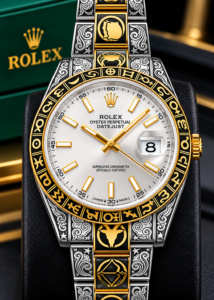
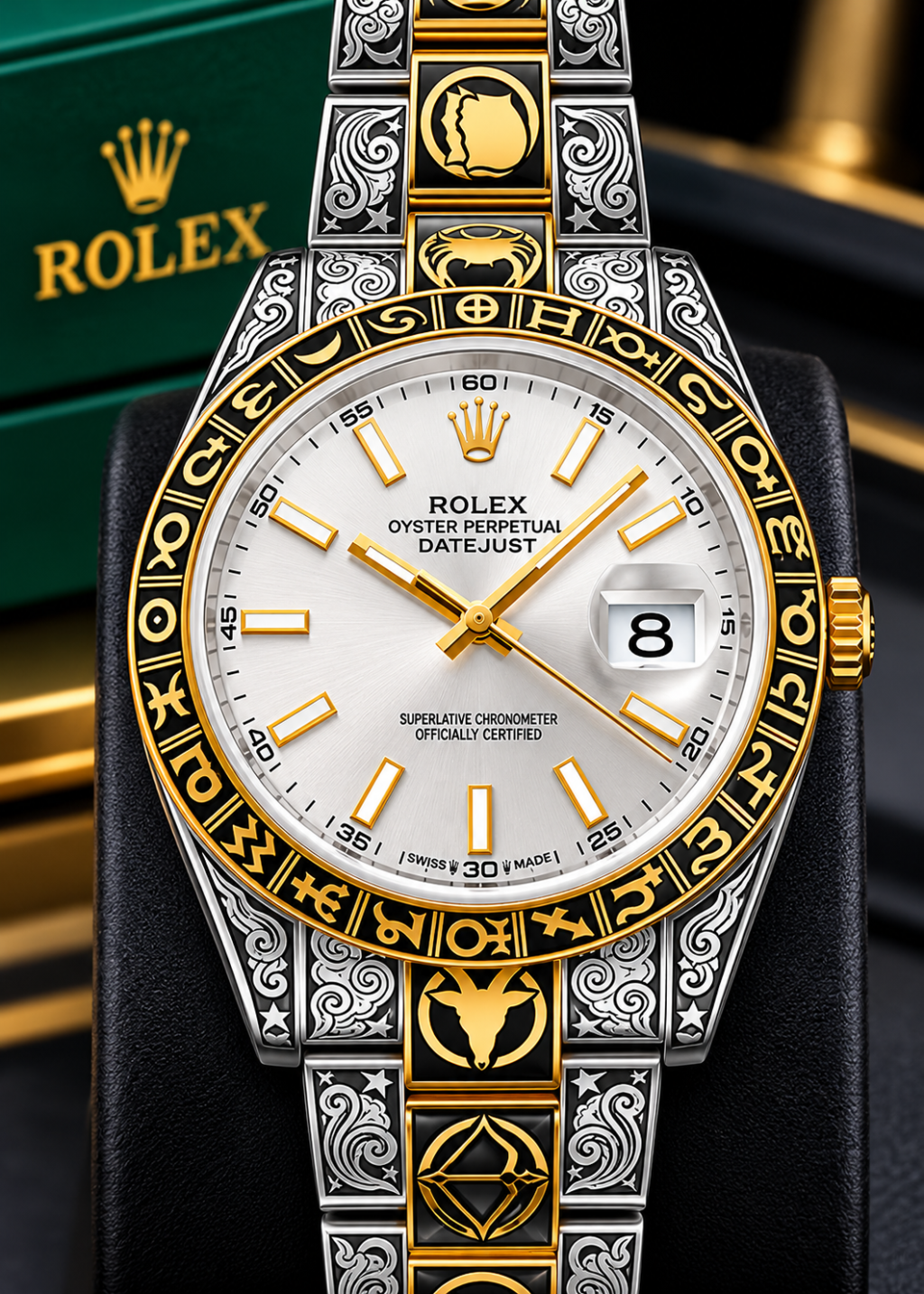
A well-designed gold and silver watch can feature a white dial, gold-colored hands, rectangular hour markers, a date window, a black-and-gold bezel, and a patterned metal bracelet. Each element contributes to its overall appearance while serving a different purpose.
However, the quality of a watch cannot be determined by its appearance alone. Its material composition, movement, manufacturing precision, crystal protection, bracelet construction, water resistance, and maintenance requirements are equally important.
This comprehensive guide explains everything readers should understand about engraved gold silver watches, including their design characteristics, materials, engineering, functionality, durability, maintenance, purchasing considerations, and long-term ownership.
1. Understanding Engraved Gold Silver Luxury Watch Design
An engraved gold silver watch is a two-tone wristwatch that incorporates decorative metal patterns and contrasting metallic finishes.
Its design combines three major elements:
Two-Tone Construction: Gold-colored and silver-colored surfaces create contrast across different components.
Decorative Engraving: Patterns, textures, and artistic details add character to the exterior.
Timekeeping Functionality: The movement operates the hands and any additional features, such as the date display.
The distribution of these elements determines the overall visual balance.
For example, silver-colored bracelet links can provide a bright foundation, while gold-colored center links create a contrasting pattern. A dark bezel with gold-colored markings can connect visually with the hands and hour markers.
The most successful designs maintain consistency between these elements without making the dial difficult to read.
When evaluating a watch, consider the relationship between its decorative details and practical features. A visually attractive exterior should also provide comfortable wear, clear time display, and reliable construction.
2. Two-Tone Gold and Silver Luxury Finishing
Two-tone finishing is a recognizable design approach in luxury watchmaking. It combines different metallic colors to create depth and contrast.
Gold introduces a warm appearance, while silver-colored metal provides a cooler and brighter finish.
These colors can be arranged in different ways.
- Gold-colored center bracelet links.
- Silver-colored outer bracelet links.
- Gold-accented bezels.
- Contrasting case surfaces.
- Gold-colored hands.
- Decorative metallic hour markers.
Types of Gold Finishing
Solid Gold: The component is manufactured from a gold alloy throughout its material thickness.
Gold Plating: A layer of gold is deposited over another underlying material.
Gold-Tone Coating: A coating or finishing process produces a gold-colored appearance without necessarily using solid gold.
Gold PVD Coating: Physical vapor deposition is a coating process that can apply a thin, durable decorative layer to suitable materials. Its performance depends on the coating composition, preparation, and application quality.
These finishes are not interchangeable. Buyers should check the actual specifications before making assumptions about precious-metal content.
Silver-Colored Finishing
Silver-colored watch components are often manufactured from stainless steel or other metal alloys.
Common finishing techniques include:
- Polishing for reflective surfaces.
- Brushing for a directional texture.
- Satin finishing for a softer appearance.
- Mixed finishing for contrasting surface details.
The quality of these finishes depends on surface preparation, manufacturing precision, and quality control.
3. Engraving Techniques and Decorative Craftsmanship
Engraving is the process of creating patterns, markings, or textures on a material’s surface.
In luxury watchmaking, it provides opportunities for artistic expression while requiring precision because watch components are relatively small.
Hand Engraving
Hand engraving uses specialized tools operated by experienced craftspeople.
It allows individual control over pattern direction, depth, and detail. Different techniques can produce floral designs, scrollwork, geometric patterns, and custom decorative elements.
Machine Engraving
Machine engraving uses mechanical equipment to create patterns with consistent dimensions.
It is particularly useful for repeated designs that require uniform spacing and positioning.
Laser Engraving
Laser engraving uses focused laser energy to create markings on compatible materials.
It can produce fine details and consistent patterns. The final appearance depends on the material and the manufacturing process.
CNC Engraving
Computer numerical control technology uses programmed movements to produce accurately positioned patterns.
It is useful for complex decorative designs that need consistent reproduction.
Common Decorative Patterns
Floral Patterns: Inspired by leaves, flowers, and natural shapes.
Geometric Patterns: Based on symmetrical shapes, repeated lines, and structured designs.
Scrollwork: Uses flowing curves and interconnected decorative elements.
Linear Patterns: Creates texture through repeated lines and carefully arranged markings.
Custom Patterns: Includes personalized initials, names, dates, or other decorative details when customization is supported.
What Makes Engraving High Quality?
Good engraving should have:
- Consistent spacing.
- Clean edges.
- Appropriate pattern depth.
- Balanced positioning.
- Smooth surrounding surfaces.
- No unnecessary damage to the underlying material.
Deep engraving is not automatically better. Excessive material removal can weaken certain components. Professional manufacturers consider both decorative appearance and structural integrity.
4. Bezel Design and Its Functions
The bezel is the outer ring surrounding the watch crystal. Depending on its construction, it can provide decorative or functional features.
A black-and-gold bezel creates contrast with a white dial and silver-colored case.
Different bezel designs include:
Fixed Bezel: Remains in one position and may feature decorative markings or a permanent scale.
Rotating Bezel: Moves around the case and can support elapsed-time measurement or other functions.
Tachymeter Bezel: Contains a scale used with a chronograph to calculate average speed over a measured distance.
Diving Bezel: Designed to help monitor elapsed time during diving activities when used according to the manufacturer’s specifications.
Decorative Bezel: Focuses primarily on visual presentation through patterns, colors, textures, or decorative materials.
Bezel Quality and Inspection
When examining a bezel, check:
- Alignment with the dial.
- Consistency of markings.
- Quality of the surface finish.
- Condition of the edges.
- Secure attachment.
- Correct operation of rotating mechanisms, where applicable.
Not every bezel containing numbers is a functional measuring instrument. Its purpose should be confirmed through the product specifications.
5. White Dial and Gold Hour Markers
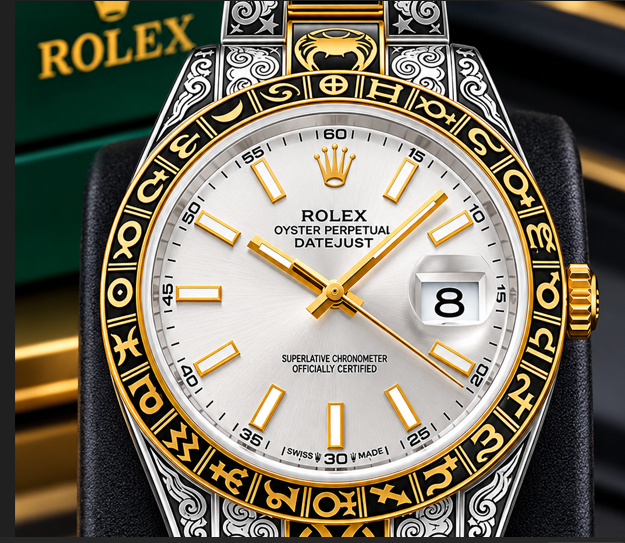
The dial is the main information display of a wristwatch. It allows the wearer to read the time and view additional information.
A white dial provides a bright background that can complement gold-colored hands and metallic hour markers.
Main Dial Components
Hour Markers: Identify the twelve primary hour positions.
Hour Hand: Indicates the current hour.
Minute Hand: Displays minutes and completes one full rotation every hour.
Seconds Hand: Displays passing seconds when included.
Minute Track: Provides additional markings around the dial for more precise time reading.
Date Window: Displays the calendar date.
Dial Printing: Contains identification, manufacturer information, and other relevant markings.
Applied Versus Printed Hour Markers
Applied markers are separate components attached to the dial surface. They can create depth and a more dimensional appearance.
Printed markers are applied directly to the dial through a printing process.
Both approaches can produce attractive results. Quality depends on accurate positioning, finishing, and readability.
Luminous Materials
Some watches include luminous material on the hands and hour markers.
These materials absorb light energy and produce visible illumination in darker environments.
Luminous performance varies according to the material, charging conditions, and design. Buyers should confirm whether the watch includes this feature rather than assuming that every luxury dial has it.
6. Date Display and Calendar Functions
A date window provides convenient access to calendar information without requiring another device.
A standard date mechanism generally uses a numbered calendar disc that advances once per day.
More advanced watches can include additional calendar complications.
| Calendar Type | Main Function |
|---|---|
| Standard Date | Displays the current date |
| Day-Date | Displays the day and date |
| Annual Calendar | Accounts for month lengths with an annual adjustment |
| Perpetual Calendar | Accounts for month lengths and leap years through its programmed mechanism |
A standard date mechanism usually requires adjustment after months with fewer than 31 days.
An annual calendar handles most month-length differences but generally needs adjustment once a year.
A perpetual calendar is more complex and is designed to account for leap years.
Important Date-Adjustment Precaution
Some mechanical movements have a restricted period during which quick date adjustment should be avoided because the calendar mechanism may already be engaged.
The safe adjustment procedure varies by movement. Owners should always consult the instruction manual.
7. Watch Materials and Their Properties
Materials influence the watch’s appearance, weight, strength, corrosion resistance, and maintenance.
Understanding these differences is essential when comparing products.
Stainless Steel
Stainless steel is widely used in watch cases and bracelets.
Its advantages include:
- Good structural strength.
- Corrosion resistance.
- Practical everyday maintenance.
- Compatibility with different surface finishes.
- Broad availability of replacement components.
Different stainless steel grades have different properties, so the specific grade should be verified when relevant.
Solid Gold
Gold is a precious metal used in some luxury watch cases, bezels, and bracelets.
Gold purity is measured in karats.
18-karat gold contains 75% pure gold by mass. Other metals are added to influence its color, strength, and workability.
Solid gold is valuable but relatively soft compared with many stainless steel alloys.
Gold-Plated Metal
Gold plating applies a gold layer over another material.
Its durability depends on plating thickness, surface preparation, manufacturing quality, and everyday use.
Repeated friction can gradually affect plated surfaces.
Gold PVD Finishing
Physical vapor deposition can create a decorative gold-colored coating on suitable components.
It is used in various products because it allows controlled surface treatment. However, its durability depends on the specific coating system and manufacturing standards.
Crystal Materials
The crystal protects the dial and influences scratch resistance and visibility.
Common materials include sapphire, mineral glass, and acrylic.
The best choice depends on the intended use, design, maintenance preferences, and budget.
8. Mechanical, Automatic and Quartz Movements
The movement is the internal mechanism that powers the watch.
Its construction influences timekeeping, maintenance, power supply, and overall ownership experience.
Mechanical Movement
Mechanical watches use a mainspring to store energy.
The gear train transfers energy through the movement, while the escapement and regulating components control its release.
Important components include:
- Mainspring.
- Barrel.
- Gear train.
- Escapement.
- Balance wheel.
- Hairspring.
- Winding mechanism.
Mechanical movements are valued for their traditional engineering and intricate construction.
Automatic Movement
Automatic movements are mechanical movements equipped with a rotor.
The rotor moves as the wearer moves their wrist, transferring energy into the winding mechanism.
This energy is stored in the mainspring and powers the watch.
The power reserve describes how long a fully wound movement can operate without additional winding.
Quartz Movement
Quartz movements use an electronic circuit and a vibrating quartz crystal to regulate timekeeping.
Most conventional quartz watches use a battery.
They are generally convenient, accurate, and relatively straightforward to maintain.
Movement Accuracy
Mechanical watches can gain or lose time depending on movement design, regulation, temperature, position, and operating conditions.
Quartz movements generally offer greater timekeeping accuracy than traditional mechanical movements.
However, actual performance should be evaluated using the manufacturer’s stated specifications.
Which Movement Should You Choose?
Choose a mechanical or automatic movement if you appreciate traditional watchmaking and mechanical engineering.
Consider quartz if you prefer convenient operation and less frequent movement maintenance.
Neither movement is universally better. The correct choice depends on the intended use and ownership preferences.
9. Sapphire Crystal and Scratch Protection
The crystal is an important protective component because it separates the dial from the external environment.
Sapphire Crystal
Synthetic sapphire is a highly scratch-resistant material commonly used in premium watches.
It helps maintain dial clarity during everyday use.
However, sapphire can still be damaged by strong impacts.
Mineral Crystal
Mineral crystal provides practical protection and is widely used in different watch categories.
It is generally more susceptible to scratching than sapphire.
Acrylic Crystal
Acrylic is a lightweight transparent material used in some watch designs.
It can be polished to reduce certain surface scratches, although it is less scratch-resistant than sapphire.
Anti-Reflective Coating
Anti-reflective coatings reduce unwanted reflections and can improve dial visibility.
Some watches feature coatings on one or both sides of the crystal.
Crystal Maintenance
Use a soft cloth suitable for the crystal material.
Avoid abrasive cleaning products and unnecessary pressure.
If the crystal becomes cracked or severely damaged, professional replacement is recommended to protect the dial and internal movement.
10. Case Construction and Watch Dimensions
The case is the protective structure that houses the movement.
It supports the crystal, crown, bezel, and case back.
Important measurements include:
- Case diameter.
- Case thickness.
- Lug-to-lug length.
- Lug width.
- Overall weight.
Case Diameter
The case diameter is usually measured across the watch without including the crown.
It influences how large the watch appears on the wrist.
Case Thickness
Thickness affects the watch’s profile and how comfortably it fits under clothing.
Lug-to-Lug Measurement
This measurement describes the distance between the outer ends of the lugs.
It helps determine how the watch sits across the wrist.
Case Back
The case back protects the movement from external exposure.
Some watches use solid case backs, while others have transparent display backs.
A transparent case back can allow the wearer to view certain movement components.
Actual construction varies by model.
11. Bracelet Design, Link Construction and Comfort
The bracelet is an important part of the overall watch experience.
It supports the case, affects comfort, and contributes significantly to appearance.
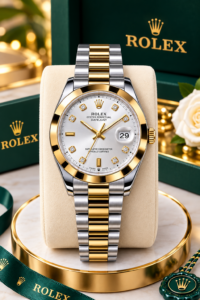
An engraved two-tone bracelet may feature silver-colored outer links, gold-colored center sections, and decorative patterns.
Common Bracelet Styles
Oyster-Style: Usually features three-piece links and a relatively structured appearance.
Jubilee-Style: Uses multiple smaller links to create a flexible and detailed appearance.
President-Style: Features a distinctive arrangement of semi-circular links.
Mesh Bracelet: Uses an interwoven metal structure.
Decorative Link Bracelet: Incorporates additional patterns or contrasting finishes.
These names describe different bracelet constructions and should only be used when the actual design matches them.
Bracelet Quality Checklist
A properly manufactured bracelet should have:
- Consistent link dimensions.
- Smooth edges.
- Secure connections.
- Appropriate flexibility.
- Reliable clasp operation.
- Suitable adjustment options.
Clasp Types
Different watches use folding clasps, deployment clasps, or other fastening mechanisms.
The clasp should close securely and operate smoothly.
Proper Bracelet Fit
A bracelet should remain secure without creating uncomfortable pressure.
Professional sizing can help achieve an appropriate fit.
Avoid attempting complicated bracelet repairs without the correct tools.
12. Water Resistance and Environmental Protection
Water resistance indicates how well a watch resists water entering its case under specified testing conditions.
It depends on the case construction, crown, case back, gaskets, seals, and overall condition.
Common ratings include:
| Rating | General Description |
|---|---|
| 30 m / 3 ATM | Limited everyday water exposure |
| 50 m / 5 ATM | Higher specified resistance; swimming suitability must be confirmed |
| 100 m / 10 ATM | May support swimming when permitted by the manufacturer |
| 200 m / 20 ATM | Commonly associated with more demanding water-related activities |
These ratings are not straightforward guarantees of safe use at the stated depth.
Factors That Can Affect Water Resistance
- Aging gaskets.
- Damaged crowns.
- Incorrectly secured case backs.
- Impact damage.
- Temperature changes.
- Previous repairs.
- General wear.
Water resistance can decrease over time.
Have the watch inspected according to manufacturer recommendations, particularly before water-related activities.
13. Comfort and Everyday Wearability
A luxury watch should be comfortable as well as visually appealing.
Several factors influence everyday wearability.
Weight: Solid metal bracelets can make a watch relatively heavy.
Case Dimensions: Diameter and thickness influence how the watch sits on the wrist.
Bracelet Flexibility: Properly designed links support natural wrist movement.
Edge Finishing: Smooth edges help prevent unnecessary discomfort.
Clasp Design: A secure and properly adjusted clasp helps maintain a stable fit.
Dial Readability: Clear markers and hands make the watch easier to use.
For everyday ownership, these practical characteristics can be more important than additional decorative details.
14. Styling an Engraved Gold Silver Watch
The combination of gold and silver finishes makes this watch style suitable for different clothing choices.
Formal Styling
It can complement suits, formal shirts, and traditional clothing.
A decorative watch can act as the main metallic accessory without requiring excessive additional decoration.
Business and Professional Styling
A coordinated two-tone watch can add a refined detail to professional clothing.
The level of decoration should suit the workplace environment.
Wedding and Special Events
Engraved metal patterns and contrasting metallic colors can complement formal accessories.
Casual Styling
For everyday outfits, the watch can provide a distinctive detail.
Comfort, fit, and practical construction should remain important considerations.
Coordinating Accessories
Gold-colored or silver-colored accessories can complement the watch.
Matching every metallic detail is not essential, but a coordinated appearance can create visual balance.
15. How to Maintain an Engraved Gold Silver Watch
Regular maintenance helps protect the exterior and internal components.
Engraved surfaces require careful cleaning because their patterns may collect dust and residue.
Routine Cleaning
Use a clean, soft microfiber cloth to remove fingerprints and surface residue.
For deeper cleaning, follow the manufacturer’s instructions.
Cleaning Engraved Areas
Small decorative grooves may collect dirt.
Use only suitable cleaning methods recommended for the watch’s materials and water-resistance condition.
Protecting Gold Plating
Avoid abrasive cloths, harsh chemicals, and unnecessary friction.
These can gradually affect plated and coated surfaces.
Protecting the Crystal
Avoid strong impacts and contact with abrasive materials.
Avoiding Chemical Exposure
Keep the watch away from solvents, strong cleaning agents, and products that may affect its finishing.
Proper Storage
Store the watch in a clean, dry location.
A suitable watch box can help protect the case and bracelet from accidental scratches.
Professional Servicing
Mechanical and automatic movements require periodic professional inspection and servicing.
Quartz watches may require battery replacement and seal inspection.
Always follow the specific manufacturer’s maintenance recommendations.
16. Common Watch Problems and Solutions
Understanding common problems can help owners recognize when professional maintenance is required.
| Problem | Possible Cause | Recommended Action |
|---|---|---|
| Watch loses time | Regulation or movement issue | Professional inspection |
| Watch stops | Exhausted power reserve or battery issue | Wind or inspect according to movement type |
| Date fails to change | Calendar mechanism issue | Follow manual or seek service |
| Bracelet becomes loose | Worn connecting components | Professional bracelet inspection |
| Clasp does not close | Adjustment or component damage | Have clasp inspected |
| Crystal becomes scratched | Surface contact | Assess material and repair options |
| Moisture appears inside | Possible seal failure | Arrange prompt professional inspection |
| Gold finish becomes worn | Friction or coating deterioration | Consult a watch specialist |
Avoid opening the case or attempting repairs on sealed components without suitable tools and experience.
17. Factors That Determine Watch Quality and Value
The overall quality and market value of a luxury watch depend on several characteristics.
Material Quality
The difference between solid gold, stainless steel, gold plating, and decorative coatings is important.
Movement Technology
Movement construction, accuracy, complexity, and serviceability influence technical quality.
Engraving Precision
Consistent patterns and clean finishing contribute to decorative quality.
Manufacturing Standards
Accurate assembly, component alignment, and quality control influence reliability.
Crystal and Case Condition
The condition of protective components affects appearance and usability.
Brand Verification
Authentic brand identity and supporting documentation can influence buyer confidence.
Service History
Professional servicing and documented maintenance can help establish the condition of a pre-owned watch.
Market Demand
Resale value depends on the specific model, condition, demand, availability, and broader market conditions.
A decorative appearance alone does not establish investment value or guarantee future appreciation.
18. How to Buy an Engraved Gold Silver Watch Online
Online purchasing requires careful research because buyers cannot physically examine every component before ordering.
Before making a purchase, review the following information.
Product Photographs: Look for clear photographs showing the dial, case, bezel, bracelet, clasp, and case back.
Material Specifications: Check the exact metal composition and finishing method.
Movement Details: Confirm the movement type and available technical information.
Dimensions: Review case diameter, thickness, bracelet width, and weight where available.
Crystal Material: Confirm whether the crystal is sapphire, mineral, or acrylic.
Water Resistance: Check the stated rating and manufacturer guidance.
Warranty: Understand what is covered and how warranty claims are handled.
Return Policy: Review the seller’s return and exchange conditions.
Seller Reputation: Check independent reviews and business information.
Authenticity: Verify brand claims through reliable documentation and authorized channels.
Questions to Ask a Seller
- What material is used for the case?
- Are the gold-colored components solid gold, plated, or coated?
- Which movement is installed?
- What type of crystal protects the dial?
- Is the bezel functional or decorative?
- What is the water-resistance rating?
- Is the bracelet adjustable?
- What warranty is included?
- Are replacement parts available?
- Is professional servicing available?
Clear answers to these questions make product comparisons more meaningful.
19. Engraved Gold Silver Watch Versus Other Luxury Watch Styles
Different luxury watch designs offer different combinations of appearance and functionality.
| Watch Style | Main Characteristics |
|---|---|
| Engraved Gold Silver Watch | Two-tone finishing and decorative metalwork |
| Minimalist Watch | Clean dial and simple exterior |
| Gold Watch | Gold-colored or precious-metal appearance |
| Silver Watch | Predominantly silver-colored metal finishing |
| Chronograph Watch | Additional stopwatch functionality |
| Skeleton Watch | Exposes selected movement components |
| Dress Watch | Generally emphasizes a refined and understated design |
| Sports Watch | Prioritizes functionality and practical construction |
An engraved two-tone watch may appeal to someone who prefers decorative metalwork, while a minimalist design may suit someone who values simplicity.
The best choice depends on individual preferences and intended use.
20. Modern Developments in Decorative Watchmaking
Modern watchmaking combines traditional craftsmanship with improved manufacturing technology.
Contemporary decorative watches may incorporate:
- Precision-machined metal components.
- Laser-created patterns.
- Improved coating processes.
- Advanced crystal materials.
- Mixed polished and brushed finishes.
- More detailed bracelet construction.
- Refined dial printing.
- Contemporary automatic and quartz movements.
These developments provide manufacturers with additional opportunities to balance decorative appearance and practical functionality.
However, modern production methods do not automatically guarantee superior quality. Material selection, engineering, manufacturing standards, and quality control remain essential.
21. Complete Buying Checklist
Use this checklist before choosing an engraved gold silver watch.
- Verify the actual case material.
- Confirm the gold finishing method.
- Identify the movement type.
- Check movement accuracy information.
- Verify the crystal material.
- Examine the engraving quality.
- Check dial readability.
- Inspect the bezel construction.
- Confirm the date mechanism.
- Review bracelet link quality.
- Test the clasp mechanism.
- Check the case dimensions.
- Confirm the water-resistance rating.
- Review the warranty.
- Check servicing availability.
- Confirm replacement-part availability.
- Verify seller reliability.
- Review authenticity documentation.
- Compare the price with actual specifications.
- Consider long-term maintenance requirements.
This checklist provides a practical framework for evaluating the complete watch rather than relying exclusively on exterior decoration.
Frequently Asked Questions
1. What Is an Engraved Gold Silver Watch?
It is a wristwatch that combines gold-colored and silver-colored finishes with decorative metal patterns. It may feature an engraved bracelet, decorative bezel, and coordinated dial.
2. What Makes This Watch Design Unique?
Its combination of two-tone finishing and decorative engraving creates visual contrast and additional exterior detail.
3. Is Every Gold-Colored Watch Made From Real Gold?
No. Gold-colored components may be solid gold, gold-plated metal, or decorative coatings. Always check the material specifications.
4. What Is the Difference Between Gold Plating and Gold PVD?
Gold plating deposits a layer of gold over another material. PVD is a coating process that can apply a decorative gold-colored layer. Their composition, construction, and durability can differ.
5. Does Engraving Make a Watch More Durable?
Not necessarily. Engraving is primarily decorative. Durability depends on the underlying material, construction, and finishing quality.
6. Which Engraving Technique Is Best?
Hand, machine, laser, and CNC engraving each have different advantages. The final quality depends on precision, workmanship, and the intended design.
7. What Is the Purpose of a Decorative Bezel?
A decorative bezel enhances the watch’s appearance through contrasting colors, patterns, and markings. Some bezels also perform timing or measurement functions.
8. Why Do Luxury Watches Use White Dials?
White dials provide a bright background that can create good contrast with metallic hands and hour markers.
9. What Is an Applied Hour Marker?
It is a separate marker attached to the dial surface rather than printed directly onto it.
10. How Does a Date Mechanism Work?
A calendar disc advances through a mechanism connected to the watch movement, displaying the current date through a dial window.
11. Which Movement Is Better for Everyday Use?
Quartz movements generally offer convenient operation, while automatic movements appeal to people who appreciate mechanical engineering. The right choice depends on the owner’s preferences.
12. What Is a Power Reserve?
Power reserve describes how long a fully wound mechanical or automatic movement can operate without additional winding.
13. Is Sapphire Crystal Better Than Mineral Crystal?
Sapphire generally provides higher scratch resistance. Mineral crystal offers a practical alternative but is more susceptible to scratching.
14. Can Sapphire Crystal Break?
Yes. Although sapphire is highly scratch-resistant, strong impacts can damage it.
15. How Can I Protect an Engraved Bracelet?
Clean it using suitable materials, avoid harsh chemicals, and follow the manufacturer’s maintenance instructions.
16. Does Gold Plating Fade Over Time?
It can wear through repeated friction and abrasion. Durability depends on the plating process, thickness, and use.
17. Can an Engraved Watch Be Worn Every Day?
Yes, provided its materials, construction, bracelet comfort, and functionality are suitable for everyday wear.
18. Is a Two-Tone Watch Suitable for Formal Clothing?
Yes. Its contrasting metallic finishes can complement suits, formal shirts, and traditional clothing.
19. What Is the Importance of Bracelet Adjustment?
Proper adjustment helps keep the watch secure and comfortable while allowing natural wrist movement.
20. Can I Wear My Watch in Water?
Only when its water-resistance rating and manufacturer instructions permit the intended activity.
21. Why Does Water Resistance Decrease?
Aging gaskets, damaged seals, impacts, and component wear can affect water resistance over time.
22. How Often Does a Mechanical Watch Need Servicing?
The recommended interval depends on the movement and manufacturer. Follow official service guidance.
23. What Causes a Watch to Stop Working?
Possible causes include an exhausted power reserve, depleted battery, mechanical fault, or other internal problem.
24. Can Scratches Be Removed From a Metal Bracelet?
Some scratches may be reduced through professional refinishing. However, polishing removes material and may affect decorative patterns or coatings.
25. What Should I Check When Buying a Pre-Owned Watch?
Review its condition, movement performance, documentation, authenticity, service history, and replacement-part availability.
26. How Can I Verify a Luxury Watch’s Authenticity?
Use authorized sellers, official documentation, and qualified professional verification where necessary.
27. Does a Luxury Watch Have Investment Value?
Some watches may retain or increase their market value, but this is never guaranteed. Model, authenticity, condition, demand, and market changes all matter.
28. Why Is Watch Weight Important?
Weight affects comfort and how the watch feels during extended wear. Case material, bracelet construction, and dimensions all contribute.
29. Are Engraved Watches Difficult to Maintain?
Not necessarily. They may require additional attention when cleaning decorative grooves, but appropriate routine care can help preserve their appearance.
30. What Is the Most Important Thing to Check Before Buying?
Verify the actual materials, movement, construction, authenticity, warranty, and seller reliability. These details provide a better indication of quality than appearance alone.
Conclusion
An Engraved Gold Silver Watch brings together decorative metalwork, contrasting finishes, and practical timekeeping. Its distinctive appearance can include a white dial, gold-colored hands, detailed hour markers, a decorative bezel, and an intricately patterned bracelet.
Understanding the watch’s construction is essential for appreciating its complete design. The materials determine its physical properties, the engraving reflects decorative craftsmanship, the movement controls timekeeping, and the crystal protects the dial.
Bracelet construction, case dimensions, water resistance, servicing, and maintenance also influence the ownership experience.
Whether someone is interested in traditional engraving, modern coating technology, automatic movements, or two-tone metal finishing, examining these characteristics helps create a more informed understanding of luxury watchmaking.
At Rolex PK, our aim is to provide clear and informative content about luxury watch styles, materials, craftsmanship, and technical features. Understanding these details allows readers to appreciate not only the visual appeal of an engraved gold silver watch but also the engineering and manufacturing considerations behind its design.
SEO Details
| Element | Content |
|---|---|
| SEO Title | Engraved Gold Silver Watch |
| Focus Keyword | Engraved Gold Silver Watch |
| URL Slug | engraved-gold-silver-watch |
| Search Intent | Informational |
| Category | Luxury Watches |
| Article Type | Comprehensive Guide |
Meta Description:
Explore the engraved gold silver watch, its two-tone design, engraving, materials, movement, features, maintenance, and complete buying guide.
Focus & Related Keywords:
- Engraved Gold Silver Watch
- Gold Silver Luxury Watch
- Two Tone Engraved Watch
- Engraved Luxury Wristwatch
- Gold Silver Men’s Watch
- Decorative Gold Watch
- Silver Bracelet Luxury Watch
- Two Tone Metal Watch
- Luxury Engraved Watch Design
- Gold Bezal
Hashtags
#EngravedGoldSilverWatch
#GoldSilverWatch
#LuxuryWatch
#TwoToneWatch
#EngravedLuxuryWatch
#GoldLuxuryWatch
#SilverLuxuryWatch
#LuxuryWristwatch
#PremiumTimepiece
#ElegantWatchDesign
#GoldAndSilverWatch
#LuxuryWatchStyle
#WatchCraftsmanship
#DecorativeWatch
#LuxuryAccessories